

The “Ghost Job” Pandemic: How to Cease Submitting Resumes for Nonexistent Jobs

The “Ghost Job” Pandemic Cease submitting resumes for nonexistent jobs –
Table Of Content
- The Subtle Destroying Effects of “Ghost Job” on Job Seekers’ Self-Assurance
- Psychological and Scientific Findings Regarding Rejection and Uncertainty
- When Everything Seems to Be Working Against You: The Unseen Battle
- True Narratives from Actual Individuals of Ghost job
- The Real Deal on How to Spot and Steer Clear of “Ghost Job”
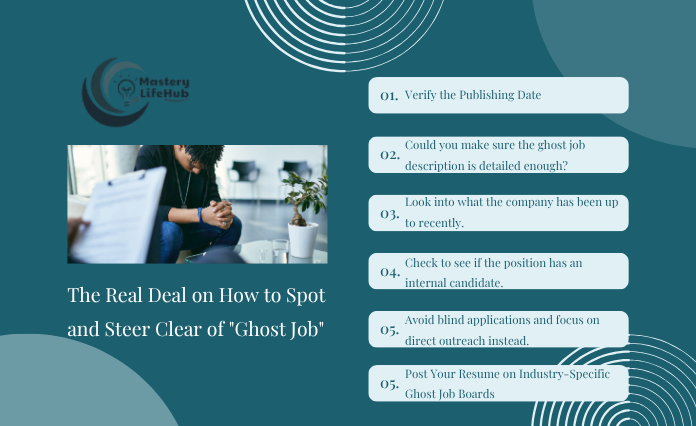
- Verify the Publishing Date
- Could you make sure the ghost job description is detailed enough?
- Look into what the company has been up to recently.
- Check to see if the position has an internal candidate.
- Avoid blind applications and focus on direct outreach instead.
- Post Your Resume on Industry-Specific Ghost Job Boards
- Improving Your Ghost Job Search Strategies for the Long Run
- Examining the Smart Search Strategy in Detail: Before and After
- Practical Measures You May Take Right Now
- Typical Fallacies and Untruths That Hold People Back From Landing a Ghost Job
- You are not failing; there is a defect in the system.
Imagine this.
On a Monday morning, you quietly expect to wake up early enough to fix your coffee and open your laptop. After spending the weekend perfecting your résumé and cover letter, you are now ready to send them out. Everything in the ad seems ideal: the job description is spot on, the compensation range is reasonable, and the company has a good reputation.
You fill out the application. Patience is required.
One week goes by. After that, there are two. After one month, another. Total absence of sound.
You send out resumes for twenty other with ghost jobs. Very same outcome. Your abilities, value, and future prospects are all called into doubt. Perhaps you are starting to question your sanity.
No one ever tells you this, but it might not even be you.
You might have been sending your resumes to “ghost job,” which are openly posted positions that the company has no plans to fill in the near future. Millions of individuals all around the world are being quietly affected by this, which is both discouraging and poorly recognized in relation to the current state of the job market.
This piece is dedicated to those who have been through the same thing, who have felt their confidence eroded by rejection or, even worse, by the quiet. I want to provide you with knowledge, tools, and a smarter approach to move forward, not just give you meaningless encouragement.
Reason being, you have agency over your decisions when your information is accurate.
The Subtle Destroying Effects of “Ghost Job” on Job Seekers’ Self-Assurance
“Ghost job” are those that appear online but are not actually filled. Any number of reasons could be at play here, including an organization’s desire to cultivate a pool of future talent, the selection of an internal candidate, or the persistence in keeping the listing up even after the position was covertly withdrawn.
This is not some little issue. Nearly half of all hiring managers actively kept job advertisements current even when they were not actively interviewing prospects, according to a 2023 poll by Clarify Capital. In a separate study, Resume Builder discovered that 20% of businesses had used phoney job postings.
You could not be getting legitimate leads from a large portion of the job postings you see on sites like LinkedIn, Indeed, and Glassdoor.
Consider the weight of that on an emotional level.
People who are looking for work, whether they are fresh grads, people making a career transition, people who have lost their ghost job, or parents trying to start over, waste a lot of time, effort, and hope on applications that do not get reviewed. They place the blame on themselves when nothing materializes.
What makes ghost job so harmful to mental health is the resulting cycle of self-blame. This is not no little professional issue. It is an issue with self-assurance. An issue with mental health. As such, it is deserving of special attention.
Psychological and Scientific Findings Regarding Rejection and Uncertainty
Being in the dark is quite unpleasant. Uncertainty is more upsetting to the human mind than a clearly negative conclusion; this phenomenon is known as ambiguity aversion in psychology. Despite the anguish, a rejection letter provides finality. Restraint yields no benefit. Not to mention that there is now complete dead air when it comes to applying for ghost job.
According to studies conducted by the American Psychological Association, adults often report that searching for a new job is one of the most difficult things that may happen to them, on par with going through a divorce or losing a loved one. Financial strain, identity crisis, and the constant barrage of societal comparisons all add up to a very trying situation.
If an applicant keeps getting the same rejection letter, the story in their head can start to take shape: I am not good enough. You can not see me. I feel out of place here.
These stories do not add up, but they sure pack a punch.
Just because you can see where the system is flawed does not mean you should give up. Embrace the opportunity to change. Experienced, well-informed individuals looking for work do not merely put in more applications. Their application is more thoughtful. They study the rules of the game so that they can go through it purposefully.
When Everything Seems to Be Working Against You: The Unseen Battle
Not everyone is willing to talk about the humiliation of an unsuccessful job hunt.
While secretly feeling sad that their three months of application process yielded no results, a recent graduate may smile at family dinners. A professional who has been out of work for ten years may put on a brave face and say they are “exploring options” when, deep down, they are scared they will never be able to get back on their feet.
If young people listen to those who promised them chances would come their way if they worked hard in school and established their resumes, they will feel even more pressure to succeed. When this fails, disappointment stings like a knife.
Every application that goes ignored is a family’s hope, a goal, and a feeling of worth for immigrants and parents who are attempting to get back into the workforce.
Because they give people false optimism, “ghost job” worsen the problem. You take notice of the posting, verify that you are qualified, and put in honest effort. Worst of all, the listing appears to be genuine. This seems like a great chance. You, or anyone else, were never supposed to have it.
You are not to blame for this. The problem is systemic. Just being aware of its existence is a huge leap forward in the fight against it.
True Narratives from Actual Individuals of Ghost job
Meena, a 26-year-old Kathmandu native and marketing graduate: After finishing her degree, she applied to more than 90 marketing roles in just five months. There were just three replies she got, and none of them resulted in interviews. Following her education on ghost job, she changed her approach, going straight to LinkedIn to contact marketing managers, joining two online communities for her industry, and landing a position in six weeks without even sending in an application.
Canadian logistics manager David, 41, just let go: In the four months after he lost his job in a company-wide layoff, he applied to sixty ghost jobs. He discovered that some of the positions he had applied for had been posted for more than 90 days, a clear sign of non-urgency, when he began to investigate ghost job signals. Instead than focusing on cold calling, he started referring people to smaller businesses that were recruiting. He secured a position that offered higher compensation than his prior one.
Priya, an Indian software developer aged 33, felt invisible while applying to major tech organizations. She shifted her attention to startups advertising on specialized job forums and Crunchbase-listed firms that had recently received funding after seeing that many large enterprises have advertisements open all year to gather candidate data. Within two weeks, she started to receive calls for interviews.
Stories like these do not stand out. These are the accounts of individuals who discovered ways to work smarter, not simply harder.
The Real Deal on How to Spot and Steer Clear of “Ghost Job”
Verify the Publishing Date
You should use caution when dealing with any listing that has been up for more than 30 days without any updates. Rapid action is taken by the majority of employing organizations. A ghost listing is one that is 60 or 90 days old.
The reason behind its effectiveness: Quickly filling a position is a top priority for many companies. In most cases, a placeholder or low priority item will have an outdated listing.
Could you make sure the ghost job description is detailed enough?
The nature of ghost work is often unclear. They provide a general description of the position without going into detail about the team’s composition, reporting structure, present difficulties, or available resources. Since a genuine hiring manager created the listing in response to a real demand, active, actual listings tend to be more comprehensive.
The reason behind its effectiveness: Urgency and purpose are conveyed through specificity. The lack of specificity indicates that the template was not revised.
Look into what the company has been up to recently.
Take a look at the business’s LinkedIn profile. In the last thirty days, have they made any updates? Have they announced funding, new product launches, or expansion? Hiring is a key component of a company’s growth strategy.
Use Crunchbase as a cross-reference for financing announcements and LinkedIn as a signal for employee development.
The reason behind its effectiveness: Dynamic businesses are gaining steam. Posting ghost job makes stagnant companies look busy when in reality they have no intention of hiring.
Check to see if the position has an internal candidate.
Find more people working there with the same title by searching LinkedIn. The listing may be out of current or displayed for compliance reasons if someone was just promoted or hired into that precise function in the past several months.
The reason behind its effectiveness: Even if an internal candidate is already in the works, many organizations are compelled to post the position externally due to procedural or regulatory requirements.
Avoid blind applications and focus on direct outreach instead.
Pick out 10 firms you would really like to work with instead of sending applications to fifty. Browse LinkedIn for the recruiting manager’s or a pertinent team member’s profile. Express your attention and appreciation with a considerate, handwritten note. This method completely sidesteps the application system.
The reason behind its effectiveness: According to LinkedIn’s own statistics, a staggering 85% of job openings are filled through referrals and direct contacts.
Post Your Resume on Industry-Specific Ghost Job Boards
Ghost jobs abound on general boards like Indeed and LinkedIn because to the ease and lack of cost associated with posting. Companies with real, unique requirements are drawn to niche boards.
Tech: AngelList (Wellfound) and Our Remote Workers
Marketing and Creative: Real ghost Job, Not Working
Idealist Nonprofits
Around the world: Offline.FlexJobs, co
Reason being: specialty forums allow employers to pay for tailored visibility. Hiring is something they take very seriously.
Improving Your Ghost Job Search Strategies for the Long Run
The advantages of switching from looking for ghost jobs blindly to strategically and intelligently have far-reaching consequences.
When you stop chasing after distractions, you gain mental clarity. When searching for signals, you already know which listings are worth focusing on. When you have a plan, you will not be as worried about the unknowns.
When you do things with purpose, your emotional resilience grows. You are actively engaging with the system, not just watching. You are making an effort to develop connections and gain exposure.
Reaching out to people personally and receiving favorable responses boosts your self-assurance in your professional abilities. Even if you do not end up with a job offer right away, just having that conversation can open doors for the future.
Above all else, you start to perceive yourself as an asset to any company, rather than just another job candidate. Everything changes with that mental adjustment.
Examining the Smart Search Strategy in Detail: Before and After
A job seeker sends out 80 applications in a 90-day period. Every cover letter is customized. They remain immobile. They get 76 silent responses and 4 automated rejections. They no longer have faith in themselves. Despite their impressive credentials, they start to question their abilities.
Following this, using the aforementioned structure, the same individual applies to fifteen carefully selected ghost job, communicates with twenty people via LinkedIn, and participates in two online industry gatherings. Five interviews take place throughout a 45-day period. Two of those turn into proposals.
It was not skill that made a difference. A strategic move.
Practical Measures You May Take Right Now
Reviews your most recent ten applications. Verify the dates of posting. When you applied, were you more than 30 days old?
Prepare a list of potential companies to approach. Make a list of fifteen businesses that you really respect. Read up on their latest developments and expansion.
Contact just one individual right now. Use LinkedIn to locate an employee at a potential employer. Express your sincere interest in their work in a short, friendly message. Just ask one good question.
Assist a single professional group. Join communities where people are actively seeking out mutually beneficial prospects, whether that is a Discord server, a Slack for business, or a local association for professionals.
Just use a basic spreadsheet to keep track of everything. The posting date, action taken, company, and follow-up date should all be listed. You might gain perspective and agency by approaching your job hunt like a project.
Applications should be limited to a certain number each day. Practise makes perfect. Twenty hurried applications are not worth as much as three thorough, tailored ones.
Typical Fallacies and Untruths That Hold People Back From Landing a Ghost Job
Myth number one: “If I apply to more jobs, I will get more interviews.” More people applying to ghost job merely makes things quieter. We are exhausted with volume without strategy.
Second Fallacy: “My resume must be the problem.” While it is true that your resume is important, it will not redeem you for a fake listing. Instead than spending too much time editing, focus on reaching out to others.
Myth number three: “Big companies are safer bets.” Ghost job tend to be more common in large businesses due to the fact that their HR systems have a tendency to auto-post roles and their pipelines are constantly “open.” Many times, smaller, rapidly expanding businesses are more open and quick to fill open positions.
Myth number four: “Networking is for extroverts.” Working a room is not what networking is all about. Networking can be as simple as sending a considerate LinkedIn message, commenting on a post, or emailing a friend from your alumni network.
Myth number five: “I should not follow up — it seems desperate.” A courteous follow-up following a week of no communication comes out as professional, not desperate. Taking the initiative is demonstrated. A lot of recruiting managers really like it.
You are not failing; there is a defect in the system.
You are not to blame if finding work has been an invisible, draining, or discouraging process for you.
The employment process has become an emotionally taxing labyrinth due to the common occurrence of ghost job, which is a genuine, well-documented problem. You can no longer run aimlessly around the labyrinth; instead, you can start making deliberate decisions about which path to take.
Refraining from applying to other job is the most effective thing you can do at the moment. It is about using clarity, not desperation, to establish a search strategy, interact with actual individuals, and apply to the correct ones.
What counts is your qualifications. There is value in your experience. An unreal listing should not dictate your future.
Do something little today. Examine a single business. Communicate with just one person. Join a single group. Every significant journey starts with that one step.
Here at MasterLifeHub, we think that having the appropriate information gives you the power to make powerful choices. The information you have gained regarding ghost job is truly powerful. Put it to good use.